
AI has just become a little less invisible.
From 2 August 2026, new transparency requirements under the EU AI Act began applying to generative AI systems. Among other things, providers of systems that generate text, images, video and audio are required to make AI-generated or manipulated content detectable in a machine-readable form.
Around 190 organisations have signed the European Commission's associated Code of Practice, including Anthropic, Google, Microsoft and OpenAI.
That does not mean everything created with ChatGPT, Claude, Gemini or Copilot will suddenly arrive with a large visible "MADE BY AI" label across it.
It does, however, signal an important shift in how AI-generated content will be treated online and how businesses should think about publishing it.
The question is no longer just whether AI can help create content. It is whether the finished content still carries enough expertise, originality and judgement to be worth publishing.
What does "watermarked" actually mean?
In many cases, the watermark is invisible.
The EU requirement is primarily about making generated content machine-readable and detectable, rather than necessarily adding a visible label for the person reading it.
Different AI companies are approaching that requirement in different ways.
Google's SynthID, for example, can embed imperceptible signals into AI-generated text, images, audio and video. These can then be detected by compatible technology without changing how the content appears to us.
OpenAI is combining technologies including C2PA Content Credentials and SynthID. Its supported generated images currently contain both metadata and an embedded watermark, while supported audio is also watermarked. OpenAI has said it intends to extend provenance signals to text as the technology develops.
Anthropic has gone further with text. It announced in August that future Claude models will generate watermarked text globally. The watermark is not a hidden character or a simple piece of metadata. Instead, subtle statistical patterns are introduced into the model's choice of words, allowing Claude-generated text to be identified without materially changing how it reads.
So this is less about putting a logo in the corner and more about introducing content provenance: a way of establishing where digital content came from and how it may have been created.
Does this mean AI-generated website content is a problem?
No.
We use AI at INDIGO, and we are enthusiastic about what it can do. It can accelerate research, explore ideas, interrogate large amounts of information, help structure an article, assist with development, generate concepts and remove a considerable amount of repetitive work.
Used well, it is an extraordinarily useful tool.
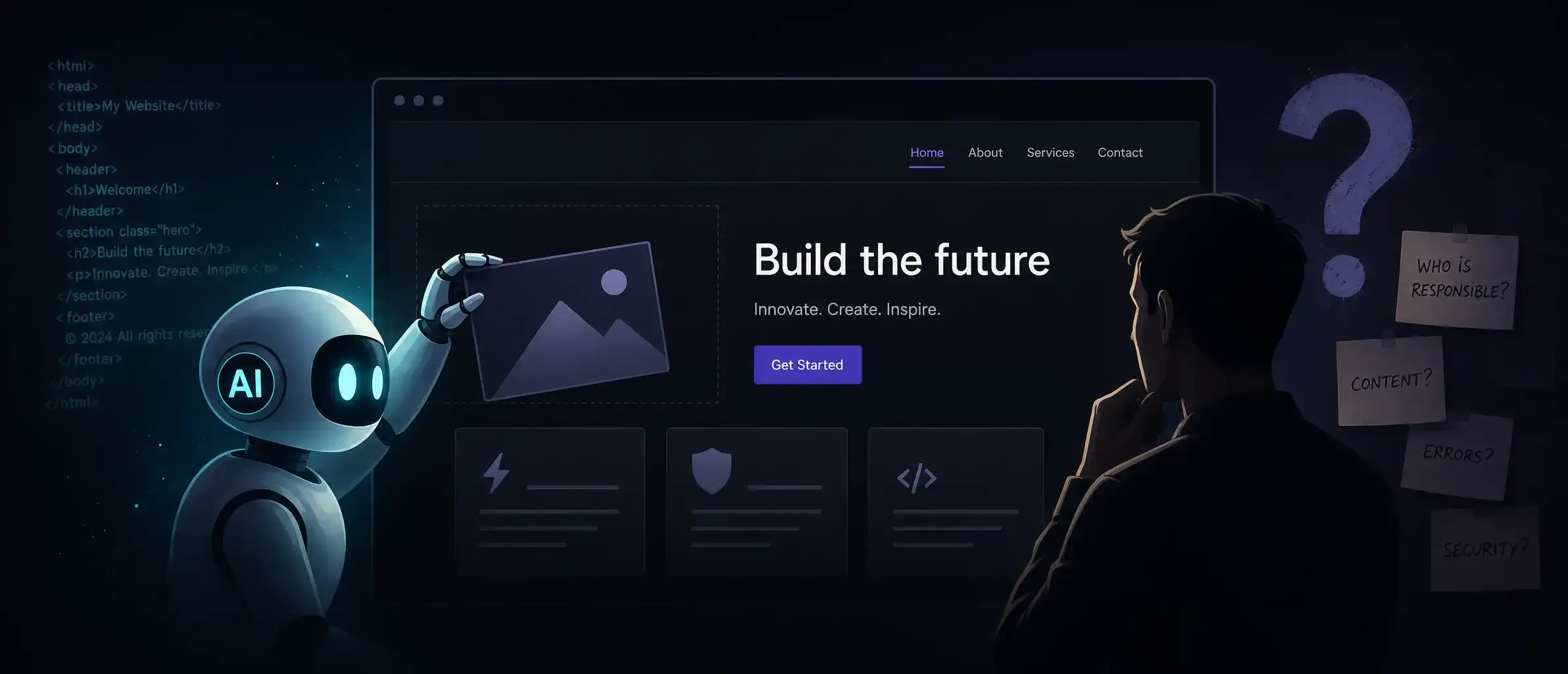
The problem arises when the tool becomes the author, strategist and decision-maker all at once.
It is increasingly easy to generate an entire website's worth of copy in an afternoon. It is equally easy for a competitor to do exactly the same thing. The result is often technically competent content that says very little that is distinctive about either business.
Watermarking does not create that problem, but it does shine a light on it. If AI-generated content becomes routinely identifiable, businesses should assume that customers, search platforms and other AI systems will become better at recognising where generative technology has played a part.
Trying to disguise that fact is not much of a strategy. Creating something worth reading is.
And what about Google?
There is an important misconception here. Google does not say that AI-generated content is automatically bad for SEO.
Its guidance focuses on the quality, accuracy, originality and usefulness of the finished content rather than simply how it was produced. Generative AI can legitimately be used as part of the content creation process.
Where Google draws the line is mass production. Using generative AI to create large numbers of pages that add little or no value can fall foul of its policy on scaled content abuse.
The better question is not "Did we use AI to create this?" It is "Does this say something useful, accurate and genuinely valuable that deserves to come from us?"
That distinction matters because AI can help produce content more efficiently, but it should not be allowed to remove the expertise that makes the content worth publishing in the first place.
The knock-on effect for business websites
We think the bigger consequence of these changes will be a gradual shift away from AI generation towards AI-assisted publishing.
That may sound like semantics, but the difference is meaningful. An AI-generated article may start with a prompt and end with whatever comes back. An AI-assisted article can use the same technology for research, interrogation, drafting and refinement, while the business supplies the experience, opinion, examples, facts and editorial judgement.
The latter is considerably harder for a competitor to reproduce.
It also raises more technical questions. Images produced by AI tools can now contain provenance metadata such as C2PA Content Credentials. Yet metadata can sometimes be removed when files are resized, converted, compressed or processed by another platform. OpenAI itself acknowledges that provenance signals may be lost through editing, conversion and some publishing workflows.
That means website owners will increasingly need to understand what happens to an asset between creation and publication. Does an image optimisation process retain its provenance information? Does the CMS? What happens when an image is converted to WebP or AVIF? What information should be retained and what should be disclosed to the user?
These are becoming website questions as much as AI questions.
Human intervention is becoming more valuable, not less
There is also an important distinction within the legislation itself. The rules recognise the difference between AI generating something and AI performing an assistive role such as standard editing. Certain assistive editing uses fall outside the provider marking requirement.
That reflects something we think businesses should already be doing: use AI to make good people more productive, not to remove the people altogether.
The same principle applies to imagery. Generating an abstract background, illustration or visual concept with AI can make perfect sense. Generating an apparently genuine photograph of your team, your product or a completed client project is a very different proposition.
The technology may be identical. The audience's reasonable expectation of authenticity is not.
So what should businesses do?
There is no need for an emergency purge of AI-generated website content. A more sensible response is to become stricter about how that content is produced, reviewed and published.
- Treat AI as part of the workflow, not the finished answer. Use it to research, explore and draft, then bring real expertise and editorial judgement into the final piece.
- Give AI something proprietary to work with. Your experience, customer questions, project results, opinions, data and expertise are what make content difficult to replicate.
- Review older AI-heavy content. If a page could sit on ten competitors' websites simply by changing the company name, it probably needs more work.
- Think carefully about authenticity. The closer an AI-generated image, video or piece of audio gets to representing something as real, the more important transparency becomes.
- Review your publishing workflow. Content provenance and metadata are likely to become increasingly important parts of managing digital assets.
For organisations publishing deepfakes or certain AI-generated text concerning matters of public interest without human editorial review, the EU AI Act introduces additional disclosure requirements, including human-readable labelling in some circumstances. Businesses operating in or targeting EU markets should therefore take specific legal advice where their use of AI goes beyond normal marketing and editorial assistance.
AI makes good digital thinking more important
After 30 years building websites, we have seen plenty of technologies that promised to completely change the way websites were created. AI probably comes closer than most.
But the fundamental job has not changed nearly as much as the technology around it. A successful website still has to understand its audience, communicate a convincing proposition, establish trust, look and behave appropriately for the business and give people a reason to choose one organisation over another.
AI can help enormously with that.
What it cannot do on its own is manufacture 30 years of expertise, a genuinely different point of view, knowledge of your customers or an understanding of what makes your business commercially valuable.
As AI-generated content becomes easier to identify, those differences may become more valuable rather than less.
At INDIGO, we are increasingly helping clients work out where AI can improve their digital presence and where human expertise still needs to lead. That covers everything from content strategy and website design to development, automation, AI integrations and making sure the finished digital experience still feels unmistakably like the business behind it.
The objective is not to create websites without AI. It is to create better websites with it.
Unsure where AI should sit in your website workflow?
INDIGO can help you decide where AI genuinely improves content, design and delivery, where human expertise still needs to lead, and how to make sure the finished website remains credible, distinctive and commercially useful.